
Showing posts with label Revolutionary War. Show all posts
Showing posts with label Revolutionary War. Show all posts
Saturday, April 9, 2016
George Will: The Battle to Save a Revolutionary War Battlefield


Saturday, December 25, 2010
Morning Bell: Remembering the Providential Gift of America
From THE HERITAGE FOUNDATION/FOUNDRY/Morning Bell, 12/24/2010
Christmas, 1776.
Summer had begun with strong declarations of noble ideals, but by winter the cause of liberty seemed to be at low ebb. Having suffered defeat after defeat, many had all but given up hope. It looked like freedom would succumb yet again, as it had throughout history, to the forces of authoritarianism and tyranny.
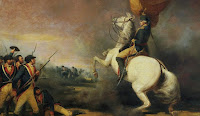
Then, on Christmas Day, 1776, a small band of colonial forces under the command of Gen. George Washington, having retreated all the way from New York, again crossed the Delaware River and brought battle at Trenton, New Jersey. Washington not only won the battle but regained the initiative and turned the war in the patriots’ favor. One week later, Washington defeated the British at Princeton and forced the enemy to withdraw, preventing its advance on Philadelphia, seat of the Continental Congress.
When it announced itself to the world in 1776, the United States of America was little more than an alliance of 13 small colonies on a barren continent, thousands of miles from their ancestral homeland, surrounded by hostile powers.
Now, well over two centuries after winning independence from the British Empire, America is the freest, wealthiest, most powerful nation on Earth. Along the way it established sovereign nationhood, settled a continent and more and brought unprecedented prosperity to its citizens. It survived a devastating Civil War that threatened its very life, abolished slavery and raised up the emancipated to be citizens equal to their one-time masters. It triumphed in two world wars fought on foreign soil and a decades-long struggle against worldwide communism that, 20 years ago, led to the fall of the Berlin Wall and collapse of the Soviet Union.
What accounts for this monumental success? The founding of the United States was indeed revolutionary. But not in the sense of replacing one set of rulers with another, or overthrowing the institutions of society. John Adams queried:
What is truly revolutionary about America is that, for the first time in history, these universal ideas became the foundation of a system of government and its political culture. Because of these principles, rather than despite them, the American Revolution culminated not in tyranny but a constitutional government that has long endured.
To this day, 233 years after Washington and his men crossed the Delaware, these principles–proclaimed in the Declaration of Independence and promulgated by the Constitution–still define us as a nation and inspire us as a people. These principles are responsible for a prosperous, just nation unlike any other. They are the highest achievements of our tradition, a beacon to those who strive for freedom but also a warning to tyrants and despots everywhere. Because of these principles, not despite them, America achieved greatness.
The Declaration of Independence, Thomas Jefferson later recorded, was “neither aiming at originality of principle or sentiment, nor yet copied from any particular and previous writing, [but] was intended to be an expression of the American mind.”
As Americans, our aim must be a clear expression and forthright defense of the nation’s principles in the public square so that they become, once again, an expression of the American mind. Despite constant scorn by academic elites, political leaders and the popular media, most Americans still believe in the uniqueness of this country and respect the Founders’ noble ideas. They may fail a test of particulars – quick: when did Washington cross the Delaware? – but they overwhelmingly want to know about this nation and its meaning.
We must give voice to all those who have not given up on their country’s experiment in self-government, have not concluded the cause of liberty and limited constitutional government is lost and have not accepted America’s decline as inevitable.
The goal must be to restore the liberating principles of the American Founding as the defining public philosophy of our nation. As it was for most of American history, so it can be again.
The joy of this wonderful season is about new beginnings and the eternal promise of redemption. We Americans have the immeasurable benefit, the providential gift, of having inherited a great country.
We must never forget its confidence, optimism and promise, its endless capacity for renewal, are contained in our dedication to the enduring principles of liberty with which all men are endowed by their Creator.
May you and yours have a merry and blessed Christmas. Read More......
Christmas, 1776.
Summer had begun with strong declarations of noble ideals, but by winter the cause of liberty seemed to be at low ebb. Having suffered defeat after defeat, many had all but given up hope. It looked like freedom would succumb yet again, as it had throughout history, to the forces of authoritarianism and tyranny.
Then, on Christmas Day, 1776, a small band of colonial forces under the command of Gen. George Washington, having retreated all the way from New York, again crossed the Delaware River and brought battle at Trenton, New Jersey. Washington not only won the battle but regained the initiative and turned the war in the patriots’ favor. One week later, Washington defeated the British at Princeton and forced the enemy to withdraw, preventing its advance on Philadelphia, seat of the Continental Congress.
When it announced itself to the world in 1776, the United States of America was little more than an alliance of 13 small colonies on a barren continent, thousands of miles from their ancestral homeland, surrounded by hostile powers.
Now, well over two centuries after winning independence from the British Empire, America is the freest, wealthiest, most powerful nation on Earth. Along the way it established sovereign nationhood, settled a continent and more and brought unprecedented prosperity to its citizens. It survived a devastating Civil War that threatened its very life, abolished slavery and raised up the emancipated to be citizens equal to their one-time masters. It triumphed in two world wars fought on foreign soil and a decades-long struggle against worldwide communism that, 20 years ago, led to the fall of the Berlin Wall and collapse of the Soviet Union.
What accounts for this monumental success? The founding of the United States was indeed revolutionary. But not in the sense of replacing one set of rulers with another, or overthrowing the institutions of society. John Adams queried:
What do we mean by the American Revolution? The revolution was in the minds and hearts of the people. . . . This radical change in the principles, opinions, sentiments, and affections of the people, was the real American Revolution.Our revolution was about the ideas upon which a new nation was to be established. Permanent truths “applicable to all men and all times,” as Abraham Lincoln later said, proclaimed that principle rather than will would be the ultimate ground of government.
What is truly revolutionary about America is that, for the first time in history, these universal ideas became the foundation of a system of government and its political culture. Because of these principles, rather than despite them, the American Revolution culminated not in tyranny but a constitutional government that has long endured.
To this day, 233 years after Washington and his men crossed the Delaware, these principles–proclaimed in the Declaration of Independence and promulgated by the Constitution–still define us as a nation and inspire us as a people. These principles are responsible for a prosperous, just nation unlike any other. They are the highest achievements of our tradition, a beacon to those who strive for freedom but also a warning to tyrants and despots everywhere. Because of these principles, not despite them, America achieved greatness.
The Declaration of Independence, Thomas Jefferson later recorded, was “neither aiming at originality of principle or sentiment, nor yet copied from any particular and previous writing, [but] was intended to be an expression of the American mind.”
As Americans, our aim must be a clear expression and forthright defense of the nation’s principles in the public square so that they become, once again, an expression of the American mind. Despite constant scorn by academic elites, political leaders and the popular media, most Americans still believe in the uniqueness of this country and respect the Founders’ noble ideas. They may fail a test of particulars – quick: when did Washington cross the Delaware? – but they overwhelmingly want to know about this nation and its meaning.
We must give voice to all those who have not given up on their country’s experiment in self-government, have not concluded the cause of liberty and limited constitutional government is lost and have not accepted America’s decline as inevitable.
The goal must be to restore the liberating principles of the American Founding as the defining public philosophy of our nation. As it was for most of American history, so it can be again.
The joy of this wonderful season is about new beginnings and the eternal promise of redemption. We Americans have the immeasurable benefit, the providential gift, of having inherited a great country.
We must never forget its confidence, optimism and promise, its endless capacity for renewal, are contained in our dedication to the enduring principles of liberty with which all men are endowed by their Creator.
May you and yours have a merry and blessed Christmas. Read More......
Tuesday, July 6, 2010
Will you risk it all?
GLENN BECK (via email/hat tip: Carolyn Webb), 7/5/2010 - [...] Most of us think of the 4th of July as the day when we declared our independence from England and began building the greatest nation the world has ever known. And while it’s true, that notion feels very much like the end of something… British rule, oppression, being subjects to a king instead of to one another. But when you stop and think about it, the 4th of July wasn’t an ending at all—it was just the beginning.
While we declared our Independence on July 4th, 1776, we had to keep fighting to defend that declaration until 1783, over seven years of bloody struggle and ultimate sacrifice. And while those who fought in the Revolutionary War knew what they were dying to protect, “we the people” didn’t adopt our Constitution until 1787, more than 11 years after those 56 men gathered in a room and signed their name to a piece of parchment that said there’s a better way for men and women to live:
In freedom.
The second sentence of the Declaration of Independence reads:
We hold these truths to be self-evident, that all men are created equal, that they are endowed by their Creator with certain unalienable Rights, that among these are Life, Liberty and the pursuit of Happiness.
The fight to live up to those 36 words continues to this day, as an ever expanding government is threatening to suppress the very freedoms our founders fought for. And while July 4th, 1776 was a major victory, let the date serve not merely as a day to remember how it all started - but also that freedom is fragile and vigilance is needed to preserve and protect it. Each and every one of us is responsible to make sure that freedom doesn't vanish on our watch. This 4th of July, think about what the founders risked to make sure they and future generations lived free - their lives, the fortunes, and their sacred honor. And ask yourself, are you willing to do the same?
God bless you, your family, and the United States of America
Glenn Beck Read More......
While we declared our Independence on July 4th, 1776, we had to keep fighting to defend that declaration until 1783, over seven years of bloody struggle and ultimate sacrifice. And while those who fought in the Revolutionary War knew what they were dying to protect, “we the people” didn’t adopt our Constitution until 1787, more than 11 years after those 56 men gathered in a room and signed their name to a piece of parchment that said there’s a better way for men and women to live:
In freedom.
The second sentence of the Declaration of Independence reads:
We hold these truths to be self-evident, that all men are created equal, that they are endowed by their Creator with certain unalienable Rights, that among these are Life, Liberty and the pursuit of Happiness.
The fight to live up to those 36 words continues to this day, as an ever expanding government is threatening to suppress the very freedoms our founders fought for. And while July 4th, 1776 was a major victory, let the date serve not merely as a day to remember how it all started - but also that freedom is fragile and vigilance is needed to preserve and protect it. Each and every one of us is responsible to make sure that freedom doesn't vanish on our watch. This 4th of July, think about what the founders risked to make sure they and future generations lived free - their lives, the fortunes, and their sacred honor. And ask yourself, are you willing to do the same?
God bless you, your family, and the United States of America
Glenn Beck Read More......
Subscribe to:
Posts (Atom)


